
Recovering from a broken collarbone is a gradual process that requires patience, proper care, and adherence to medical advice. Here’s a quick summary of what to expect:
- Week 1-4: Initial pain and swelling are managed with immobilization via a sling and prescribed medications, gradually subsiding as the bone begins to heal.
- Week 5-8: Light activities may be permitted upon physician approval, with adults typically required to wear a sling for 6 to 8 weeks.
- Week 8 and beyond: Full healing typically occurs within 8 to 12 weeks, with physical therapy recommended to restore strength and mobility.
If you are searching for broken collarbone treatment near you, understanding this week-by-week healing process helps you set realistic expectations and heal with confidence.
Understanding Broken Collarbone Treatment Near You
A broken collarbone is a common injury that causes pain and limits shoulder function. Fortunately, most fractures respond well to conservative, non-surgical care.
What Is a Broken Collarbone?
The clavicle, or collarbone, connects your breastbone (sternum) to your shoulder blade (scapula).
According to Harvard Health, approximately 80% of all collarbone fractures occur in the middle third of the bone, most commonly resulting from a fall onto an outstretched arm or a direct impact to the shoulder.
Symptoms of a broken collarbone are typically immediate and easy to identify:
- Severe pain over the fracture site
- Swelling, tenderness, and bruising
- A grinding or crackling sensation (crepitus) when you try to move your shoulder
- Difficulty lifting your arm due to pain
- A visible bump or deformity over the break
When to Seek Emergency Care
Seek immediate medical attention if you experience any of the following:
- The bone protrudes through the skin (an open fracture)
- A significant deformity appears, or the arm looks shortened
- You feel numbness, weakness, or a “pins and needles” sensation in your arm or hand
- The hand or arm feels cold, pale, or takes on a bluish tint
Why Conservative Treatment Is Preferred
For most clavicle fractures, conservative, non-surgical management is the preferred approach. In fact, according to the Cleveland Clinic, only a small percentage of cases require surgical intervention.
Rather than exposing patients to the risks associated with surgery, we prioritize treatments that support the body’s natural healing process. This method is both effective and centered on patient well-being.
Initial Diagnosis and Assessment
Accurate diagnosis begins with a thorough physical examination. We assess for swelling, deformity, skin integrity, range of motion, and nerve function.
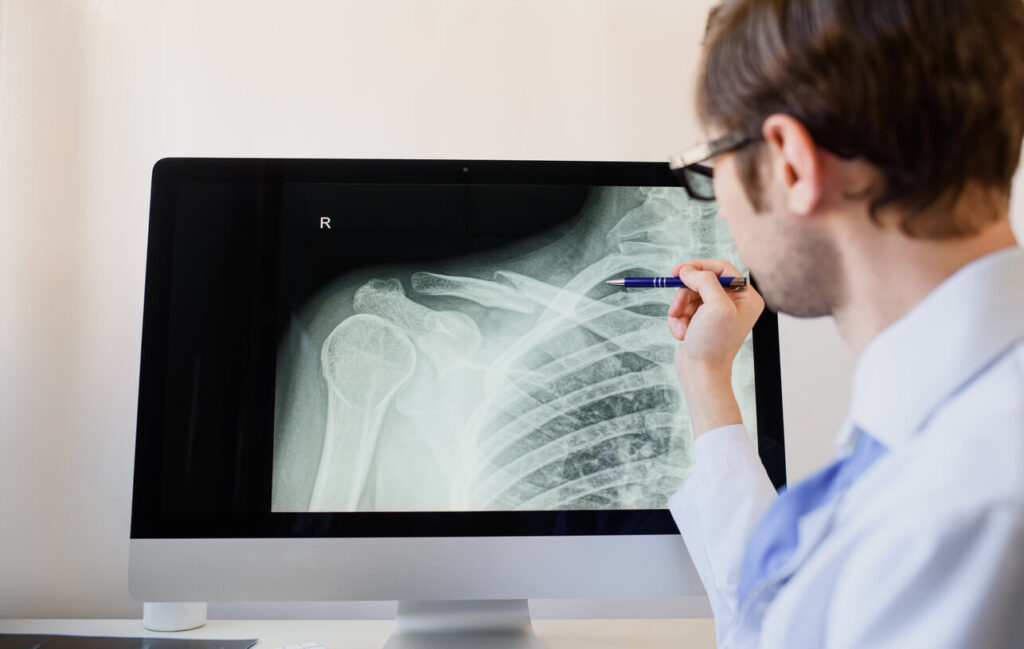
An X-ray confirms the fracture, revealing its location, degree of displacement, and whether the bone is broken into multiple pieces (comminuted).
For complex fractures or suspected nearby injuries, a CT scan may provide a more detailed view.
How Conservative Broken Collarbone Treatment Near You Works
Conservative treatment creates the ideal environment for bone healing through three pillars: immobilization, pain management, and rehabilitation.
The Science of Bone Healing
Bone healing occurs in distinct stages:
- Inflammation stage: Your body launches an inflammatory response, forming a hematoma that provides initial stability and a framework for new bone.
- Soft callus formation: The hematoma is replaced by a soft, cartilaginous callus that bridges the broken bone ends.
- Hard callus formation: The soft callus converts into a hard, bony callus that solidifies the fracture site and unites the fragments.
- Bone remodeling: Over months to years, your body reshapes and strengthens the bony callus in response to everyday stress.
The Role of Immobilization
Immobilization is essential to conservative care. A simple arm sling holds the broken bone ends still, supports the weight of your arm, and prevents misalignment.
It also reminds you to rest the injured shoulder. This stability allows the callus to form without disruption, which reduces pain and promotes a strong bone union.
Pain Management Strategies
Managing pain and swelling matters most in the first one to two weeks. We often recommend over-the-counter pain relievers like acetaminophen or NSAIDs such as ibuprofen.
Applying ice packs for 15 to 20 minutes several times a day also provides relief. Effective pain control keeps you comfortable and supports healing. Always consult your doctor before starting any new medication.
The Step-by-Step Recovery Process
Recovery moves from complete rest to the gradual reintroduction of movement and activity, guided every step of the way by your orthopaedic specialist.
Immediate Care and Immobilization
Right after diagnosis, your arm goes into a supportive sling. Wear it continuously, even while sleeping, to maintain proper position and protect the healing bone.
Focus on rest, and avoid lifting, pushing, pulling, or reaching with the affected arm.
Sling Duration and Early Stages
Immobilization time varies by age because younger bones heal faster:
- Children (under 8): Typically need a sling for about 3 to 6 weeks.
- Adolescents: Usually wear a sling for 6 to 8 weeks.
- Adults: Generally require a sling for 6 to 8 weeks before beginning motion.
During this stage, perform gentle finger, wrist, and elbow exercises to maintain joint mobility and prevent stiffness.
Transition to Gentle Movement
Once an X-ray confirms sufficient healing (often shown by callus formation), you will gradually wean off the sling. Start with gentle, passive range-of-motion exercises, in which a therapist moves your arm for you.
From there, progress to active exercises that use your own muscles. The goal is to restore mobility without stressing the healing fracture.
Expected Timeline and Milestones
Healing varies from person to person, but this general timeline sets realistic recovery expectations.
Weeks 1–2: Acute Phase
During the first two weeks, strict immobilization and pain control are the primary focus. Intense pain should begin to subside, and basic activities such as sleeping and self-care will gradually become more manageable.
Rest is paramount during this phase. Keep your arm in the sling at all times, apply ice regularly, and take pain medication as directed by your physician.
Weeks 3–6: Early Healing Phase
During weeks 3–6, adults should continue wearing the sling diligently, while children, who typically heal at a faster rate, may be cleared for gentle, supervised movement.
Pain should decrease significantly during this period, and X-rays will likely begin to show initial callus formation, indicating that the healing process is progressing as expected.
Weeks 6–12: Rehabilitation Phase
During the rehabilitation phase, the primary focus is on restoring shoulder mobility and rebuilding strength. Most adults will discontinue the use of their sling around 6 to 8 weeks post-injury and begin formal physical therapy.
Under the guidance of a qualified physical therapist, patients progress through targeted range-of-motion exercises followed by light isometric strengthening.
Light daily activities can be gradually resumed during this period, though heavy lifting and overhead reaching should continue to be avoided until cleared by your physician.
Beyond 12 Weeks: Full Recovery and Return to Activity
Beyond the 12-week mark, the primary focus shifts to regaining full strength, function, and confidence in the shoulder. At this stage, X-rays should confirm solid bone union, and patients are expected to achieve full, pain-free range of motion with strength comparable to the uninjured side.
Under the guidance of a specialist, patients may gradually return to more strenuous activities, including sports, overhead work, and heavy lifting. Full clearance to resume these activities is contingent on the complete restoration of shoulder strength and function.
Common Myths About Broken Collarbone Recovery
Misconceptions can lead patients to make poor choices during recovery. Here are the facts.
Myth: All broken collarbones need surgery.
Most clavicle fractures heal well with a sling and time. Surgery is reserved for specific cases, such as severe displacement or open fractures.
Myth: If you can move your arm, it is not really broken.
Some patients retain limited movement despite a genuine fracture. Only an X-ray can confirm the injury, so never skip an evaluation.
Myth: Once the pain fades, you can return to full activity.
Pain typically subsides before the bone has fully healed. Returning to activity too soon risks re-injury or delayed recovery. Always follow your specialist’s clinical benchmarks rather than relying on your comfort level alone.
Rehabilitation and Long-Term Well-Being
Successful recovery depends on restoring full, pain-free shoulder function, not just healing the bone.
The Role of Physical Therapy
Physical therapy is a cornerstone of recovery. A qualified therapist creates a personalized program to safely rebuild range of motion, flexibility, and strength. They guide your exercises, ensure proper form, and help you progress at a safe pace.
Safe Return to Activity
Patience pays off. Returning to sports or strenuous work too early risks re-injury or delayed healing.
Your specialist and therapist provide clear benchmarks for full clearance, typically full range of motion and strength equal to your uninjured side.
Preventing Re-Injury
After recovery, protecting your shoulder health matters. A maintenance program of strengthening exercises keeps the surrounding muscles strong and stable. For contact sports or high-risk activities, always use proper technique and wear protective equipment.
Frequently Asked Questions (FAQ)
Here are answers to common concerns about recovery and broken collarbone treatment near you in San Antonio, TX, to help you stay informed and proactive in your healing process.
How long does a broken collarbone treatment near me take?
Most adults heal within 6 to 12 weeks, though a full return to strenuous activity can take longer. Children often heal faster. Your specialist will track your progress with X-rays and adjust your timeline as needed.
Do I need surgery for a broken collarbone?
Most clavicle fractures heal well without surgery. Doctors reserve surgery for severe displacement, open fractures, or associated nerve and blood vessel injuries. Our qualified providers offering broken collarbone treatment near you can determine the best approach for your injury.
How do I find broken collarbone treatment near me?
Look for a practice with board-certified orthopaedic specialists, on-site imaging, and a full rehabilitation team. Prompt evaluation ensures an accurate diagnosis and the most effective treatment plan for your fracture.
When can I return to sports after a broken collarbone?
Return to sports typically happens after 12 weeks, once X-rays show solid bone union and you regain full, pain-free strength and motion. Always wait for your specialist’s clearance to avoid re-injury.
Find the Right Broken Collarbone Treatment Near You in San Antonio, TX
A broken collarbone can significantly limit your daily activities, but with the right care, you can return to full function.
Our board-certified orthopaedic specialists provide thorough evaluations, advanced diagnostics, and personalized rehabilitation plans to support every stage of your recovery.
If you or a loved one has sustained a clavicle fracture, contact us today. Call (210) 692-7400 or complete our online appointment request form to schedule a consultation.
