
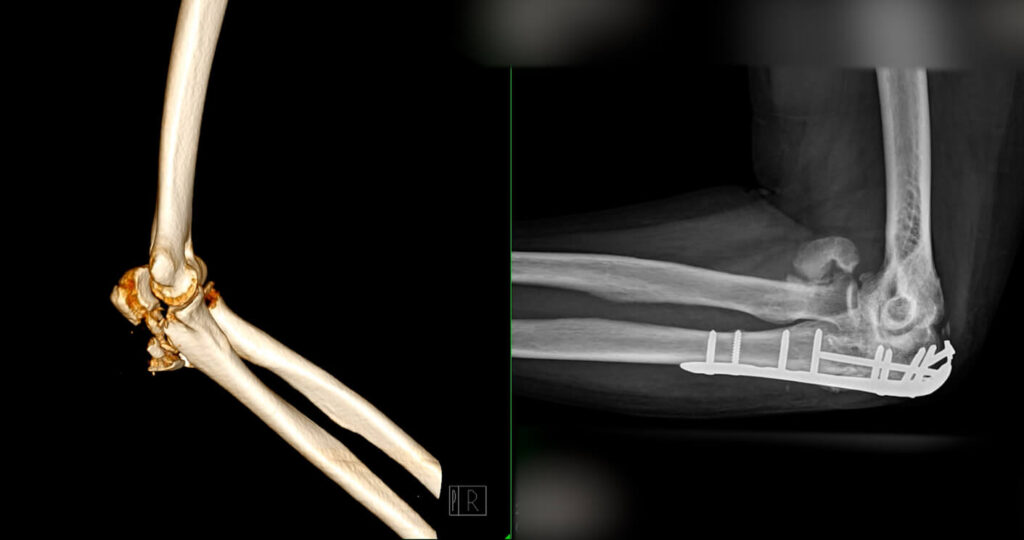
Elbow fracture recovery typically takes 6 to 12 weeks for minor fractures and up to 12 months for complex cases. Recovery progresses through distinct phases: immobilization, physical therapy, and gradual return to activity. Early treatment and consistent rehabilitation are the strongest predictors of a full recovery.
In short:
- Recovery takes time. Most elbow fractures require 6 weeks to 12 months of healing, depending on fracture severity.
- Rehabilitation is essential. Physical therapy restores range of motion, strength, and function after immobilization.
- Early care matters. Seeking elbow fracture treatment near you promptly reduces the risk of long-term complications like stiffness and arthritis.
If you are searching for elbow fracture treatment near you after a fall, accident, or sports injury, knowing what to expect during recovery can make the process far less overwhelming. An elbow fracture is a break in one or more of the three bones that form the elbow joint — the humerus, radius, and ulna.
Recovery is not a single event. It is a carefully staged process that unfolds over weeks and months, guided by the type of fracture, your age, your overall health, and the treatment approach your orthopedic specialist recommends.
This guide walks you through the elbow fracture recovery timeline week by week, explains what happens in your body at each stage, and outlines what you can realistically expect — from the day of injury through your return to full activity.
What Are the Different Types of Elbow Fractures?
Not all elbow fractures are the same, and the type you sustain directly affects your recovery timeline. The most common types include:
- Olecranon fractures: A break in the bony tip of the elbow, often caused by a direct blow or fall onto a bent elbow
- Radial head fractures: A break at the top of the radius bone, typically caused by falling on an outstretched hand
- Distal humerus fractures: A break at the lower end of the upper arm bone, more common in older adults due to osteoporosis
- Coronoid process fractures: A break at the front of the ulna, often occurring alongside dislocations
According to the American Academy of Orthopaedic Surgeons (AAOS), radial head and neck fractures account for approximately one-third of all elbow fractures in adults. Understanding your fracture type is the foundation of your treatment plan.
How Is an Elbow Fracture Diagnosed?
Diagnosis begins with a physical examination and a standard X-ray to identify the location and severity of the break. In complex cases, your orthopedic provider may order a CT scan (computed tomography scan) to assess bone alignment and joint involvement in greater detail. MRI imaging may also be used to evaluate surrounding soft tissue, ligaments, and cartilage.
Fracture severity is typically classified using the Mason classification system for radial head fractures or similar grading systems for other elbow fractures. Classification guides the decision between nonsurgical and surgical treatment.
Elbow Fracture Treatment Options: Surgical vs. Nonsurgical
Treatment depends on how displaced, or out of position, the bone fragments are and whether the joint surface is involved.
When Is Nonsurgical Treatment Used?
Nondisplaced or minimally displaced fractures, where bone fragments remain well-aligned, are typically managed without surgery. Treatment usually involves:
- A splint or cast worn for 2 to 6 weeks
- Anti-inflammatory medications such as ibuprofen (Advil, Motrin) or naproxen (Aleve) for pain management
- Ice therapy and elevation in the early days
- Gradual physical therapy once initial healing is confirmed
When Is Surgery Required?
Displaced fractures, fractures involving joint surfaces, and fractures combined with elbow dislocations usually require surgical intervention. Surgical options include:
- Open reduction and internal fixation (ORIF): Metal plates, screws, or pins hold bone fragments in place while healing occurs
- Radial head replacement: A metal implant to replace the bone is used when the radial head is too damaged to repair
- Total elbow arthroplasty: Reserved for severely comminuted distal humerus fractures, particularly in older adults
Elbow Fracture Recovery Timeline: Week by Week
Recovery from an elbow fracture does not follow one universal path. The timeline below reflects general expectations for a moderately severe fracture managed non-surgically. Surgical cases follow a similar structure but may involve a longer immobilization phase.
Week 1 to 2: Immobilization and Inflammation Control
The priority in the first two weeks is controlling pain, swelling, and protecting the fracture site. Your arm will be immobilized in a splint or cast, typically with the elbow bent at 90 degrees.
During this phase:
- Swelling and bruising peak within the first 48 to 72 hours
- Elevation of the arm above heart level reduces swelling
- Ice packs applied for 15 to 20 minutes several times daily help manage inflammation
- Pain medications prescribed or recommended by your provider manage discomfort
- Finger and wrist movement is usually encouraged to prevent stiffness in adjacent joints
It is important to avoid placing any weight through the injured arm and to follow all immobilization instructions precisely. Disrupting the fracture site early can delay healing significantly.
Week 3 to 4: Early Bone Healing Begins
By the third week, the body begins forming a soft callus between the broken bone ends. This is a critical phase of fracture repair.
You may notice:
- Gradual reduction in swelling and bruising
- Persistent stiffness in the elbow joint due to immobilization
- Follow-up imaging to confirm callus formation
Your orthopedic provider may begin transitioning you from a rigid cast to a removable splint, allowing limited supervised movement. Do not remove immobilization devices without medical guidance, even if the pain has subsided. Bone that feels stable externally may still be fragile internally.
Week 5 to 6: Transition to Physical Therapy
For many nonsurgical fractures, the 5- to 6-week mark signals the beginning of formal physical therapy. Callus maturation continues, and the bone becomes progressively stronger.
Physical therapy at this stage typically focuses on:
- Range-of-motion exercises: Gentle, guided bending and straightening of the elbow to prevent permanent stiffness
- Forearm rotation exercises: Restoring the ability to turn the palm up and down (supination and pronation)
- Edema management: Massage and compression techniques to address lingering swelling
Week 7 to 10: Strengthening and Functional Restoration
As bone consolidation progresses, physical therapy shifts from mobility to strength and function. The hard callus formed during this phase is gradually replaced by mature lamellar bone — the structural bone that provides lasting strength.
Rehabilitation during this stage includes:
- Progressive resistance exercises targeting the biceps, triceps, and forearm muscles
- Functional activity retraining, such as reaching, lifting, and carrying light objects
- Work-specific or sport-specific exercises if relevant to your daily activities
Pain should be decreasing steadily. Persistent or worsening pain during this phase warrants evaluation, as it may indicate complications such as nonunion (failure of the bone to heal) or post-traumatic arthritis.
Week 11 to 12: Return to Daily Activities (for Nonsurgical Cases)
Most patients with nondisplaced or minimally displaced fractures managed without surgery can expect to return to most daily activities by 10 to 12 weeks. Return to full activity, including heavy lifting and contact sports, typically requires clearance from your orthopedic specialist based on clinical examination and follow-up imaging.
At this stage:
- Bone healing is largely complete for simple fractures
- Residual stiffness may still be present and continues to improve with therapy
- Gradual reintroduction of demanding activities is supervised to prevent re-injury
Month 3 to 12: Recovery After Surgical Treatment
For patients who undergo surgery, recovery extends well beyond 12 weeks. Following ORIF or radial head replacement, the typical recovery timeline looks like this:
- Weeks 1 to 2: Wound care, splinting, and pain management
- Weeks 3 to 6: Protected range-of-motion exercises under therapist guidance
- Months 2 to 3: Progressive strengthening begins once surgical hardware is stable
- Months 4 to 6: Return to light occupational or athletic activities
- Months 6 to 12: Full recovery and return to high-demand activities, depending on fracture complexity
What Factors Affect How Long Elbow Fracture Recovery Takes?
Several variables influence the pace of healing and the quality of functional recovery:
- Fracture type and severity: Complex, comminuted, or displaced fractures take longer to heal than simple, nondisplaced breaks
- Age: Bone healing slows with age, particularly in individuals over 60
- Bone density: Patients with osteoporosis may experience delayed healing and increased fracture complexity
- Underlying health conditions: Conditions such as diabetes and smoking have been shown to impair bone healing
- Treatment compliance: Attending all follow-up appointments, completing physical therapy, and following activity restrictions directly affects outcomes
- Time to treatment: Delays in seeking elbow fracture treatment near you can allow fracture displacement to worsen
What Are the Potential Complications of an Elbow Fracture?
Even with proper treatment, complications can occur. The most common include:
- Elbow stiffness: The most frequently reported long-term issue, often requiring prolonged physical therapy or, in rare cases, surgical release
- Post-traumatic arthritis: Cartilage damage at the time of fracture can lead to arthritic changes over time
- Nerve injury: Injury to the ulnar nerve during the fracture or surgery may cause numbness, tingling, or weakness in the hand
- Nonunion or malunion: Bones that fail to heal or heal in an abnormal position may require additional intervention
- Heterotopic ossification: Abnormal bone formation in soft tissue around the elbow, which can limit motion
Early and consistent care, including seeking qualified elbow fracture treatment near you, is the most effective strategy for minimizing these risks.
Frequently Asked Questions (FAQ)
Whether caused by a sudden fall or an athletic injury, an elbow injury requires prompt, expert evaluation to prevent long-term stiffness and restore full arm mobility. Below, you’ll find answers to common questions about finding elbow fracture treatment near you.
How long does it take for an elbow fracture to heal completely?
Simple, nondisplaced elbow fractures typically heal in 6 to 8 weeks. More complex or surgically treated fractures may require 6 to 12 months before full functional recovery is achieved. Bone consolidation and soft tissue healing continue even after pain has resolved.
Can I move my fingers and wrist while my elbow is in a cast?
Yes — and you should. Moving your fingers, hand, and wrist while your elbow is immobilized helps maintain circulation, reduces swelling, and prevents stiffness in joints that are not injured. Your orthopedic provider will guide you on what movement is safe.
When can I return to work after an elbow fracture?
Return to work depends on your job demands and fracture severity. Sedentary or desk-based workers may return within 2 to 4 weeks with immobilization in place. Those with physically demanding jobs may require 3 to 6 months before full duty clearance, particularly after surgery.
Is physical therapy necessary for elbow fracture treatment near me?
Physical therapy is strongly recommended for most elbow fractures, both surgical and nonsurgical. The elbow joint is particularly prone to stiffness following immobilization, and structured rehabilitation is the most effective way to restore range of motion, strength, and function.
What medications are used to manage pain after an elbow fracture?
Nonsteroidal anti-inflammatory drugs (NSAIDs) such as ibuprofen (Advil, Motrin) and naproxen (Aleve) are commonly used for mild to moderate pain. For more severe fractures or after surgery, short-term prescription pain relievers may be used under medical supervision. Always take medications exactly as directed by your provider.
Can an elbow fracture cause long-term stiffness or disability?
Yes, elbow stiffness is the most common long-term complication. However, most patients who complete a full course of physical therapy recover meaningful function. Severe stiffness that does not respond to therapy may require surgical intervention, such as an arthroscopic or open release procedure.
Find Expert Elbow Fracture Treatment in San Antonio, TX
Recovering from an elbow fracture requires more than time, it requires the right team, the right treatment plan, and the right rehabilitation strategy from day one.
At the Center for Orthopaedic Surgery and Sports Medicine, our board-certified orthopedic specialists provide comprehensive evaluation and individualized care for all types of elbow fractures, from nondisplaced breaks treated with immobilization to complex fractures requiring advanced surgical repair.
If you are looking for elbow fracture treatment near you, do not wait. Earlier intervention leads to better outcomes, reduced complication risk, and a faster return to the activities that matter most to you.
Contact us today at (210) 692-7400 or use our online form to schedule your consultation and take the first step toward a full recovery.
